
Herbs and Essential Oils for Asthma Support
Find out how medicinal herbs and some essential oils can support the respiratory system in the case of asthma. Asthma is a condition that differs between individuals, and herbalists look at each person uniquely. According to Heidi Villegas, clinical herbalist, aromatherapist, author, and teacher, herbal remedies can be very helpful in chronic conditions such as symptoms related to asthma.

Ready to learn herbalism? Even if you’re time-challenged (who isn’t?) signing up for this quick but solid email course can get you started making remedies today. You can also save the lessons and come back to them when you have time! Click here to enroll FREE. Every extended family and community needs an herbalist.
Understanding Asthma and How Plants and Herbal Strategies Can Help
When I was about eight years old, my little brother had an asthma attack and nearly died. My mom’s screams and cries woke up my little sister and I in the middle of the night. I remember my dad picking my little brother up in his arms. Wide-eyed, I saw his little blue lips and closed eyes, and then I burst into tears myself.
My dad raced him into the car while my mom and brother took up the back seat, my mom trying to revive him as they raced to the hospital in the dark, wee hours. It was certainly a blessing this happened in the early morning hours as there was no traffic. I’m sure my dad was flying. My little sister and I were left at home, but it was ok back in those days, in the 1960’s.
We were so relieved to see my little brother, alive and well, come home in a few hours. My brother lived through this attack, but asthma has been a fear for me ever since.
When my daughter was diagnosed with asthma at age eight and was prescribed an inhaler, I remember feeling relief that we had this emergency “just-in-case” plan. I couldn’t imagine seeing my little girl as I saw my brother that night.
Now, as an herbalist, I feel even more empowered in my approaches with asthma for several reasons. First, scientists understand asthma better now. Second, after working with God’s medicinal herbs for decades, I know that we have some incredible options in our medicinal plants! And third, after you experience an asthma attack a few times, you KNOW when medical care is necessary, and it’s best not to wait. Medicinal plants can be wonderful helpers, both for prevention as well as if an attack does happen and while you call for medical help.
Let’s take a look at asthma and how we might use the glorious medicinal plants God has so graciously gifted us here on earth.

Click HERE and I’ll send you your FREE Herbal Remedy Guide for 10 common and easy to find herbs PLUS a handy cheat sheet!
What Is Asthma?
Asthma is a condition that makes it hard to breathe. To understand asthma, imagine your lungs are like a tree with thousands of tiny branches. These branches, called airways, carry air in and out of your lungs with every breath you take.
When someone has asthma, their airways don't work quite right. Instead of staying open and relaxed, three problems happen at the same time:
A Squeeze: The muscles wrapped around your airways tighten up like a fist, making the breathing tubes much narrower. It's like trying to breathe through a coffee stirrer instead of a regular straw.
Swelling and Inflammation: The walls of your airways get puffy and inflamed, similar to how your skin swells up after a bee sting. This puffiness makes the airways even smaller, also allowing less oxygen through.
Gunky Mucus: Your body starts making thick, sticky mucus that clogs up the already narrow airways. Mucus production is normally a type of protection, but with those suffering asthma, there is more than usual, and it blocks the insides of airways. Imagine trying to breathe through a straw that's partially filled with honey – that's what it feels like.
When all three of these problems happen together, breathing becomes terribly difficult. People with asthma might wheeze (make a whistling sound when breathing), cough a lot, feel tightness in their chest, or feel short of breath.
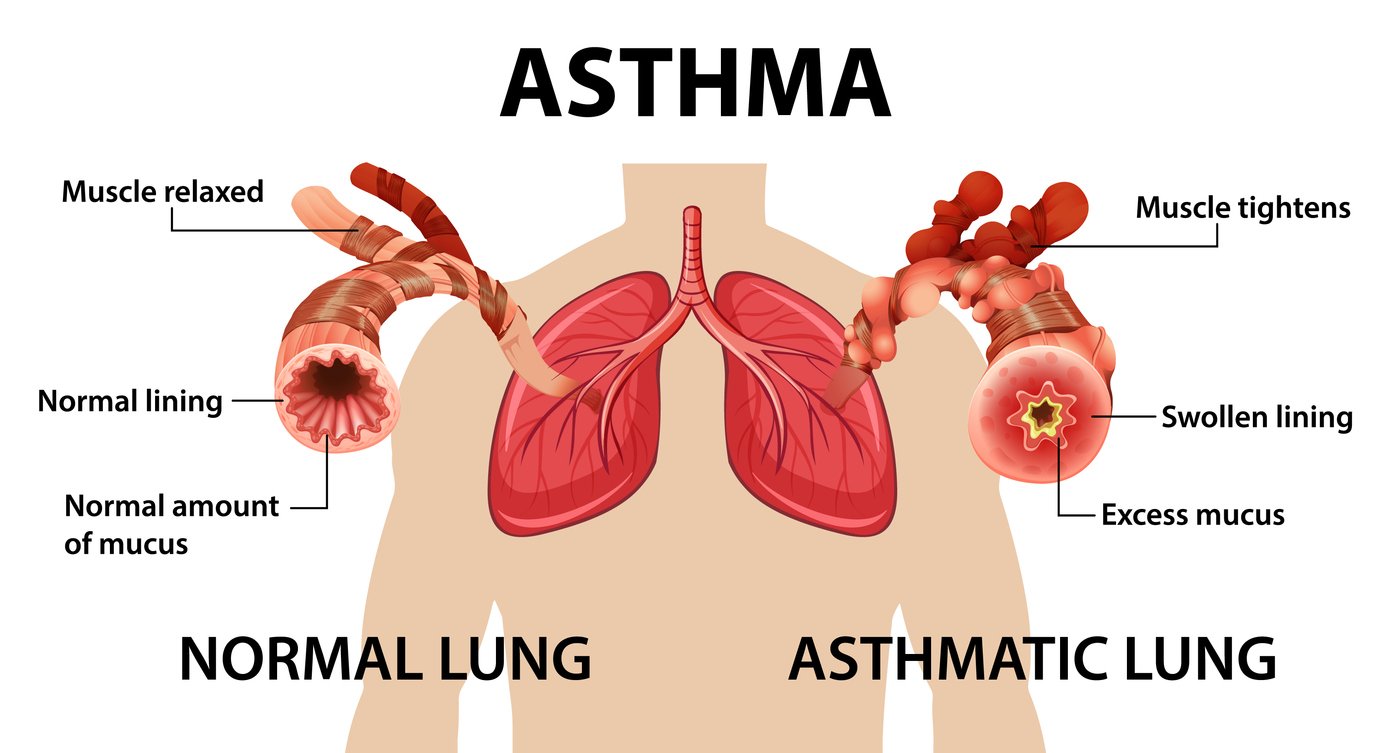
Image credit: blueringmedia via istockphoto.com
Why Does Asthma Happen?
Your body has special guard cells called mast cells that act like security guards, protecting you from harmful invaders like germs. These mast cells live in your airways and other parts of your body.
The problem with asthma is that these guard cells get confused. They start treating harmless things – like pollen, cat fur, dust, or cold air – as if they're dangerous enemies. When mast cells “panic,” they release tiny pouches filled with chemicals. These chemicals are what cause the three main asthma problems: the squeezing, the inflammation/swelling, and the extra mucus.
Some of these chemicals have names like histamine and leukotrienes. Leukotrienes are especially powerful – they're actually 100 to 1,000 times stronger than histamine at making airways squeeze tight! Histamine is getting a lot of attention these days, but there are other chemicals involved in asthma attacks that need to be considered.
Different Types of Asthma
Not everyone's asthma acts the same way. Understanding what type of asthma you have helps you know which treatments will work best.
Allergic Asthma: This is the most common type. It happens when you breathe in something you're allergic to, like pollen, mold, dust mites, or pet dander. Your immune system overreacts and triggers an asthma attack.
Exercise-Induced Asthma: Some people's airways get tight when they exercise, especially in cold air. Their breathing gets faster during exercise, which can dry out and cool down the airways, which may trigger symptoms.
Cold-Weather Asthma: For some people, breathing in cold air makes their airways squeeze tight. These people often feel cold in general and may have lots of mucus already.
Stress-Triggered Asthma: Strong emotions or stress can also trigger asthma symptoms. When you're anxious or upset, your body releases chemicals that can make airways more sensitive and reactive.
Mucus-Dominant Asthma: Some people produce excessive thick mucus that's hard to cough up. This type often comes with frequent coughing and a feeling of congestion in the chest.

Join one of our Family Herbalist education programs! From foundational knowledge and apothecary to a complete certification program! Click here!
How Plants Can Help
For thousands of years, people have used plants to help with breathing problems. Different plants work in different ways to address the various problems that happen with asthma. Think of it like having different tools in a toolbox – each tool does a specific job.
Although herbs should not be substituted for medications (because they work differently than drugs), there are many that can be helpful in an acute situation where medication isn’t available and also for tonic, preventative use.
Herbs to Support the Lungs with Asthma
Herbs That Relax Tight Airways
Cramp bark (Viburnum opulus) is one of the best herbs for relaxing the muscles around your airways. It’s very helpful for bronchial spasms. It works by blocking the calcium that muscle cells need to squeeze tight. When you take crampbark, it helps those panicked muscles relax and let your airways open back up. You can take it as a tincture (liquid extract) or drink it as a tea made by simmering the bark.
Wild Cherry bark (Prunus serotina) is one of my own personal favorites for supporting calm lungs when there are bronchial spasms involved or tightness.
Caffeinated herbs such as coffee, green tea, and yerba mate’ might surprise you, but they actually work as mild bronchodilators (airway-openers). They contain natural chemicals called methylxanthines and theophylline that help relax airway muscles.
Many people find that drinking a cup of strong coffee or even the more gentle yerba mate’ tea during an asthma attack actually helps them breathe easier. Green tea (Camellia sinensis) is another helper that has been positively studied and found to help reduce inflammation in the lungs.
In fact, a popular herb in Traditional Chinese Medicine (TCM) is Ephedra sinensis (not to be confused with Ephedra nevadensis, or Mormon Tea, which grows natively in the U.S. Southwest). This is a very powerful stimulant herb that is now banned in most places in the United States, but can be very helpful for asthma attacks when used properly. It is a low dose herb, so I suggest avoiding it unless you are working with your herbalist and medical team.
The important thing to know about using herbs containing high levels of caffeine and other stimulants is that the effects are not the same as prescription bronchodilators. Research shows that caffeine may help with a bronchodilating effect, and it may last up to four hours.
Herbs That Calm Down Guard Cells
Remember those overreactive mast cells we talked about? Some herbs can help calm them down so they don't release all those trouble-making chemicals in the first place.
Nettle (Urtica dioica) is a common plant that grows wild in many places. Even though the fresh plant stings when you touch it due to the formic acid in the tiny needles it has, once it's dried or cooked, it becomes a powerful and nutritious medicine. Nettle contains natural antihistamines that block histamine from causing problems. It also helps stabilize mast cell membranes, making them less likely to release their chemicals. You can drink nettle as a tea or take it as a tincture. Nettle is best used as a tonic, over time.
Wild Bergamot (Monarda fistulosa), also called Bee Balm, is a beautiful plant with purple flowers that often grows in gardens. It contains rosmarinic acid, which helps strengthen mast cell membranes and prevents them from dumping out inflammatory chemicals. It also has a pleasant smell and taste, making it easy to take as a tea. Rosemary is another herb that contains high levels of rosmarinic acid.
Plantain (Plantago spp), the weed, not the banana-like fruit, is another common plant that probably grows in your yard. It contains compounds that strengthen cell membranes and reduce inflammation. The leaves can be made into tea or tincture.
Herbs That Stop Swelling and Inflammation
Willow bark (Salix spp) has been used for thousands of years to reduce pain and inflammation. It contains salicin, which your body converts into salicylic acid – the same active ingredient in aspirin. Willow helps reduce the swelling in your airways and calms down inflammation. However, if you're allergic to aspirin or take blood-thinning medications, you should avoid willow.
Nettle works here too! Besides calming mast cells, it also has anti-inflammatory properties that help reduce airway swelling through multiple pathways.
Various tonic herbs with strong anti-inflammatory actions may also be helpful when taken daily and consistently. Herbs such as Turmeric (Curcuma longa), black pepper (Piper nigrum), ginger (Zingiber officinale) and others may have helpful generalized effects on inflammation in the body.
Herbs That Help Clear Mucus
Wild Bergamot (Monarda fistulosa) once again! Its aromatic oils help thin mucus and make it easier to cough up. The pleasant-smelling vapor also helps open airways when you breathe it in as an herbal steam.
Plantain (Plantago spp) has a special quality – it's both soothing and helps with mucus. It contains mucilage, a slippery substance that coats irritated airways while helping to loosen stuck mucus.
Elecampane (Inula helenium) has a strong traditional history of use for respiratory ailments, including asthma attack. In fact, it’s one of the key ingredients in my formula for Lung Support Tea, which you can find here on my website and also on my YouTube channel. I created that recipe for a three-year-old little boy with asthma many years ago, and his mother ended up also using it as a tonic tea. Since then hundreds (maybe thousands) of my students and clients have found it helpful.
Mullein (Verbascum thapsis) is another of my favorite herbs for respiratory support. It’s generally very safe for most people, and is a strong harmonizer in herbal formulations for both upper and lower respiratory issues.

Ready to make herbalism and/or aromatherapy part of your daily life? Find out more and check out our school here!
Making Simple Herbal Remedies When Asthma Strikes
The ideas here are just that: generalized thoughts about how you might begin working with herbs for asthma. Remember that everybody’s body is different. Asthma sufferers all present symptoms and root causes differently, too. Although these are therefore not hard and fast protocols, they will give you some ideas.
Here are some practical formulas you can make or buy:
For Emergency Breathing Help
When you're having trouble breathing right now, try this:
Drink 6-8 ounces of strong hot coffee or mate tea
Take 3 droppers-full (about 3ml) of cramp bark and/or wild cherry bark tincture
Take 1 dropper-full (about 1 ml) of elecampane tincture
Take 1 dropper-full (about 1ml) of wild bergamot tincture
You can mix the tinctures right into your hot beverage. The coffee starts working in about 10-20 minutes, while the crampbark takes 15-30 minutes to reach full effect.
For Daily Prevention
To help prevent asthma attacks, here are some more generalized ideas:
Morning:
Drink a big glass (8 ounces) of nettle tea that you made the night before (strong infusion). Natural antihistamines in the nettle build up in the body when taken over time which potentially then support seasonal allergies and asthma issues.
Have 1-2 cups of coffee or mate tea with 1 dropper of wild bergamot tincture added
Take 2 droppers-full of a mixed tincture containing nettle, wild bergamot, and plantain
Midday:
Take 2 droppers-full of an anti-inflammatory blend (willow, nettle, turmeric, black pepper, and wild bergamot)
Evening:
Take 2 droppers-full of cramp bark tincture
Make your nettle tea for tomorrow morning
For Exercise-Induced Asthma
Before Exercise (30-45 minutes):
Drink a cup of strong coffee or mate tea
Take 2 droppers of cramp bark or wild cherry bark tincture
Take 1 dropper of wild bergamot tincture
After Exercise:
Drink nettle with ginger or turmeric tea to help calm any inflammation

Matching Herbs to Your Body Type
Western herbalists use a system of energetics to help them determine which herbs are helpful for which kinds of people. This section alludes to this understanding, but there’s a lot that goes into learning this knowledge. Regardless, matching herbs to individuals is important to understand at some point in your herbalism journey. Here are some easy things to consider as you work with the people in your life who struggle.
People with asthma often fall into different patterns, and knowing your pattern helps you choose the best herbs:
The "Hot" Type
If you get red in the face, feel hot, have very sudden and intense reactions, and your asthma comes on fast and strong, you're probably a "hot" type.
You should:
Use more nettle and plantain (cooling herbs)
Add extra willow bark for its cooling effects
Drink iced or room-temperature teas
Go easy on coffee – use mate tea instead
The "Cold" Type
If you feel cold easily, produce lots of clear or white mucus, have pale skin, and feel weak or tired, you're probably a "cold" type. You should:
Use more wild bergamot and turmeric/black pepper (warming herbs)
Drink hot beverages instead of cold
Use coffee instead of mate (it's more stimulating)
Focus on herbs that help clear mucus
The "Anxious" Type (Tension)
If stress and anxiety trigger your asthma, or if you're generally an anxious person, you should:
Use more wild bergamot (it's calming)
Use cramp bark to help with tension
Be careful with coffee – it might make anxiety worse
Try mate tea instead, which is gentler
Make tea-drinking a calming ritual, and perhaps try some chamomile tea.
Here’s one of my lung supportive herbal tea blends. Medicinal herbs can be very helpful for the respiratory system!
Essential Oils that May be Helpful in Asthma Attack
Aromatherapeutic, and high quality essential oils can be supportive for some people who experience asthma. In fact, I’ve had helpful results from the following essential oils:
Inula (Inula graveolens) is an essential oil distilled from the leaves and flower of the plant. It contains high levels of bornyl acetate (anti-inflammatory, antispasmodic, expectorant, sedative) and borneol (vasorelaxant, sedative, anti-inflammatory), and this is why it’s such a helper when inhaled. It is commonly used by aromatherapists for a wide variety of respiratory conditions, including asthma. I’ve even used it for pets, including a cat with asthma with helpful results.
Black Spruce (Picea mariana) is also high in bornyl acetate. It is antispasmodic, relaxing, anti-inflammatory, expectorant, and also decongesting.
There are other potential aromatic helpers including Eucalyptus spp, Peppermint (Mentha x piperita), Rosemary (Rosmarinus officinalis syn. Salvia rosmarinus), and others. However, sometimes very powerful bronchial openers can actually irritate asthma, so proceed with caution with your essential oils. If a person inhales one and feels any tightening in the chest, this would be a sign for that person to avoid the essential oil.
You can test a person’s reaction by holding an open bottle about chest-height and allowing the client to smell. Move it closer to the nostrils if there is no discomfort or tightening of the lungs or chest. If the person indicates any kind of tightening or discomfort, this is not an essential oil for the person to use.
Once again, we must remember that herbs are not drugs, and a good herbalist will never treat one person the same as another. We’re all different, and our presentations of asthma will be different too.
Important Safety Information Using Herbs & Oils for Asthma
While herbs can be very helpful, here are some important things to know:
When to See a Doctor: If you're having a severe asthma attack and herbs aren't helping within 30 minutes, or if the person is struggling badly, you need medical care right away. Severe asthma attacks can be life-threatening.
Drug Interactions:
Willow bark acts like aspirin, so avoid it if you take blood thinners or are allergic to aspirin unless your doctor says otherwise.
Coffee, green tea, and yerba mate contain caffeine, so be mindful if you're sensitive to caffeine or take certain medications
Always tell your doctor about any herbs you're taking or essential oils you’re using for medicinal purposes
Pregnancy and Nursing: Many herbs and some essential oils aren't recommended during pregnancy or breastfeeding. Check with an herbalist and your healthcare provider if you are pregnant or nursing.
The Power of Combination
Here's something really important: using multiple herbs (and essential oils) together works better than using just one herb alone. Herbalists call this "synergy."
Think of it like cleaning a messy room. You could just vacuum, but that won't pick up the toys. You could just pick up toys, but that won't clean the carpet. But if you vacuum AND pick up toys AND dust, you get much better results!
The same thing happens with herbs for asthma. When you combine:
Herbs that calm mast cells (nettle, wild bergamot, plantain)
Herbs that relax airways (cramp bark, elecampane, wild cherry bark, coffee)
Herbs that reduce inflammation (willow, ginger, nettle)
Herbs that clear mucus (wild bergamot, plantain, elecampane, mullein)
Then, you’re attacking the asthma problem from multiple angles at once, which is much more effective than just addressing one issue.

Final Thoughts
Asthma can be scary and frustrating, but understanding what's happening in your body helps you take control. Plants offer gentle, natural support that can work alongside modern medicine. If you have asthma, you should plan to keep your inhaler handy, just in case.
The herbs we've talked about – nettle, wild bergamot, plantain, cramp bark, willow, coffee, turmeric, black pepper, ginger, green tea, wild cherry bark, elecampane, mullein, and mate – are generally easy to find, affordable, and safe for most people when used correctly. Many of them might even grow in your own backyard!
Your body is incredibly intelligent and wants to heal itself. Sometimes it just needs a little gentle support from the plants God has gifted us to help humans breathe easier for thousands of years. With patience and consistency, the right herbs, and helpful guidance, many people find they can breathe easier and have fewer asthma symptoms over time.
Breathing is life's most basic function, and has been since God breathed life into us. We all desire to breathe freely and easily, and plants can be powerful allies in that journey toward improved respiratory health.
Heidi’s Lung Tea Formula
This formulation is the one I created as a daily tonic to support the lungs. It can be tinctured as well, which can help with compliance due to the fact that the dose may be added to a pleasant tasting liquid. This tea doesn’t taste great, but it’s helped many of my clients and students.
Ingredients:
2 parts dried mullein leaf (Verbascum thapsis)
2 parts dried elecampane root (Inula helenium)
2 parts dried peppermint leaf (Mentha x piperita)
2 parts dried marshmallow root (Althaea officinalis)
1 part dried echinacea leaf or root (Echinacea spp)
1 part dried wild cherry bark (Prunus serotina)
1 part dried chamomile (Matricaria recutita)
1 part dried ginger rhizome (Zingiber officinale)
Directions for an Herbal Tea:
Blend the herbs together and store in an airtight jar in a dark cupboard.
To make your herbal tea, use about a tablespoon per 10 to 12 ounces of just boiled water. Steep for 45 minutes to an hour. It will be strong and bitter, but more effective with a longer steep. Alternatively, since this blend contains a high number of “hard” plant parts (bark and root), you may choose to decoct your herbs (a low simmer) for 15 minutes or so.
Directions for an Herbal Tincture:
Fill a wide-mouthed quart mason jar about 1/3 to just under 1/2 full. Pour 80 proof (40% alcohol) or 100 proof (50% alcohol) over the herbs to within an inch of the top of the jar.
Shake the jar daily. I like to place my processing tinctures in an area with gentle warmth, as this helps the herbs release their constituents.
After 4 to 6 weeks, strain off the liquid and bottle it up. Store in a cool, dark place.
A typical amount to take for an average adult about 150 pounds is approximately 1/2 teaspoon (three full droppers). You can take this tincture several times a day if needed, or choose to take a bit daily as a tonic.
I hope you enjoyed this herbal information on how to handle asthma naturally
For more information, be sure to bookmark our website (Healing Harvest Homestead) and our YouTube channel (and please subscribe and share)! Thank you for being here in our herbal world….
Hugs, Health, and Herbs,
Heidi