
Western Herbalism: What Do We Call Qi, Ojas, or Prana?
This is an article on how someone practicing herbalism from a Western Herbalist perspective can find meaning and comparisons with Eastern Herbalism terms such as Ojas, Qi/Chi, and Prana. According to clinical herbalist, teacher, and author, Heidi Villegas, there are clear overlaps between Eastern herbal energetics practices and traditional Western herbal energetics. In this article, she erases the confusion.
Western herbalism is a newer practice of herbal medicine. Worldwide, herbalism has been practiced in all cultures for all time, but there are only a few recognized herbalism “medical” practices, and the two main ones originate out of Eastern philosophies (Ayurveda-India and TCM-China). There are many others, of course, including the earth-based medicine of indigenous peoples around the world, including the ancient tribes of Europe and Asia.

There are many overlaps among these herbalism practices, and it’s helpful to understand them. One concept that practitioners should understand is Qi, Prana, Ojas, and what we in the West commonly call Vital Life Force (or innate vitality).
When you have a healthy reserve of Vital Force, your eyes sparkle, you feel calm and peaceful, you have energy, and you feel well. This Vital Force is something that an herbalist practicing in the Western Herbal tradition would equate with Eastern Herbalism concepts such as Ojas and Prana (Ayurveda) and Qi/Chi (Traditional Chinese Medicine). Our Western Herbalism concept of Vital Force also includes “spiritus,” meaning the “breath of life.”
There is no direct, exact definition in Western Herbalism for these ideas from Eastern Herbalism, but in this article, I’m hoping to clear any confusion or misunderstanding.

We all aim for the type of vitality described by Qi, Ojas, and Vital Force!
This is the goal of the Western herbalist—-to help bring unbalanced bodies back into balanced states of being so that vitality is maximized!
All of these terms describe forms of vital life-force, vitality, resilience, constitutional strength, and also the body’s innate ability to maintain health. The closest term in Western herbalism to those used in Ayurveda or TCM is Vital Force, which encompasses all of the above concepts, with some subtle differences. Let’s look at a comparison of the terms:
Here is a simple comparison:
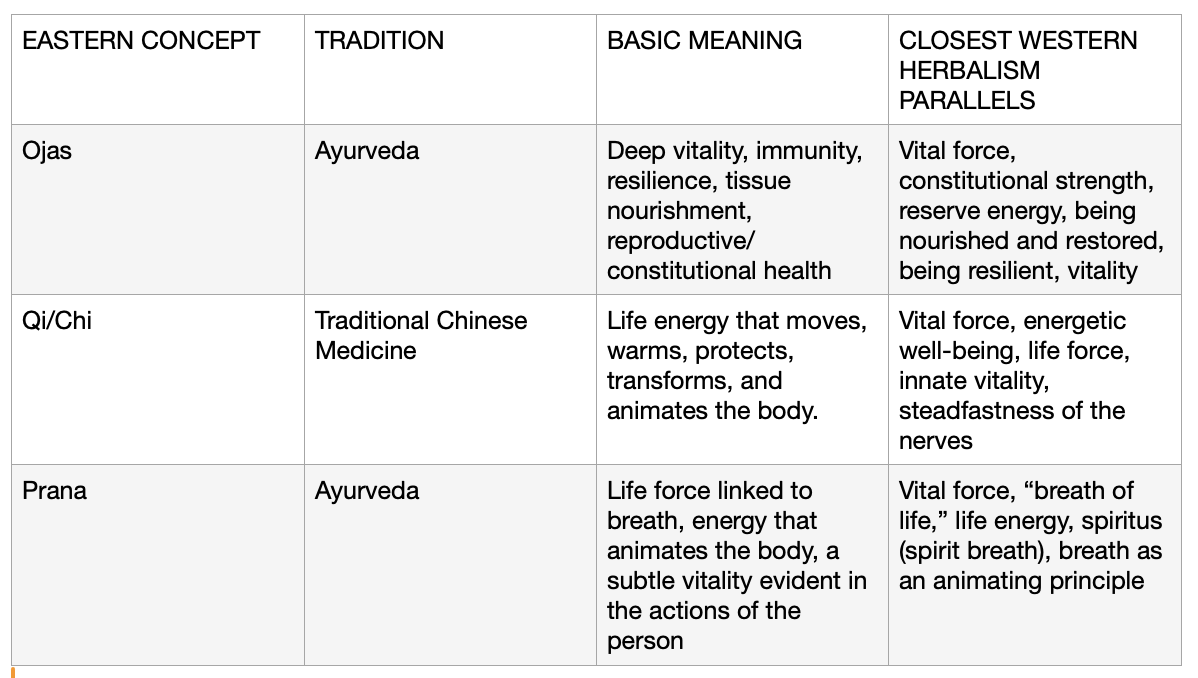
This is my attempt, as a practicing herbalist in the relatively new Western tradition (dating back to the Ancient Greeks) and with a background in Ayurveda, to connect the dots between the practices and reduce confusion for newer herbalists.
Let’s Discuss Vital Force in Western Herbalism
Vital force is the body’s inherent life energy. It’s the organizing intelligence of the body, mind, and spirit that maintains health, repairs tissue, resists disease, and restores balance. It’s not exactly the same as the Eastern terminology of Qi, Prana, or Ojas, but it very strongly overlaps with all of them.
We might say something like, “This person’s vital force is low.”
This means they are depleted, generally fatigued, experiencing brain fog, less resilient, slower to recover from illness or injury, more reactive to stressors, malnourished, tired from lack of rest, and in need of minerals, tonics, and gentle rebuilding of mind and body.

Digging a Little More Deeply
Comparing Ojas to Vital Force
Ojas is closely related to a person’s constitutional vitality, which is their baseline strength and resilience, their constitution, how much reserve energy they have.
Reserve energy isn’t like “coffee energy.” Instead it’s a deeply stored capacity, the kind that we need to help us recover from big events such as giving birth, grieving a death, becoming very ill, long-time chronic stress and lack of sleep, and generalized depletion.
Ojas is closely tied to nourishment, fluids, tissues, immunity, fertility, a “glow,” calmness, and a stable emotional state. In Western herbal language, we would be considering herbs in categories such as nutritive tonics, restoratives, adaptogens, nervines, and demulcents for rebuilding and supporting.
A person with strong Ojas would be described in Western herbalism as having excellent constitutional strength, a steady energy, a healthy immune system, emotional balance, one who sleeps well, has good tissue tone throughout the body, and is resilient—both emotionally and physically.
In Western herbalism, the equivalent to Ojas would be having a deep constitutional vitality and reserve strength, especially through the body’s nourished capacity for resilience, immunity, repair, reproduction, and emotional balance. Vital Force.
Comparing Qi with Vital Force
While Ojas is more of a state, Qi is more dynamic. It moves, protects, warms, and transforms.
In TCM, vital force is the animating energy behind all body processes, and vital energy is the body’s ability to digest, circulate, breathe, eliminate, think, move, and to recover.
In addition to these similarities with Ojas, Qi includes the idea of transformational power. In Western herbalism, having a weak digestive system, a cold constitutional state, fatigue after eating or doing typical daily tasks, sluggishness, may be described as low vitality or we might say poor digestive tone.
In older Western herbal practices, some of the physiomedical language and text uses ideas like “nerve force,” especially when considering exhaustion, overstimulation, collapse, or processes that are poorly regulated.
For Qi, the closest Western definition might be the body’s active vital energy: the force that supports movement, warmth, digestion, circulation, protection, and functional strength.

Comparing Prana to Vital Force
This was the trickiest, especially because as a Christian herbalist, we consider the Holy Spirit and “spiritus” as God-breathed life.
Prana is associated with breath, life, subtle energy (chakras, etc.), and principles of animation/movement.
In my practice of Western herbalism, I parallel Prana with:
1) Spiritus/spirit
The Latin “spiritus” means breath or spirit. And historically, “spirit” was connected to breath, life, movement and vitality. We see this in terms like, “What a spirited child.”
2) Breath of Life
I think intuitively, this is the most easily connected term to Prana
3) Animating Principle
This is rather philosophical, I think. It’s the thing that gives life to the body and makes it more than just physical matter.
4) Vital Force
Simply, this is the best Western equivalent.
So, for Prana, a Western-style definition could be “The breath-linked life force or animating vitality that enlivens the body, mind, and spirit.”

Western Herbal Categories that Support These Comparisons of Energetic Terms
In Western herbalism, we don’t say, “build ojas,” or “strengthen qi.” Instead we generally talk about herbal actions that are necessary to support a healthier more balanced vital force in a person. These include:
1) Nutritive herbs:
Herbs that feed and replenish the body, which are often rich in minerals. These include nettle leaves, alfalfa, chickweed, horsetail, red clover, and oatstraw.
2) Tonics herbs:
These are herbs used over time to strengthen tissues in the body, organs and systems, and that help with whole-body function. Tonic herbs include nettle leaf and root, dandelion root and leaf, hawthorn, milky oats.
3) Adaptogens
Adaptogens are herbs that help the body adapt to stress and rebuild resilience. Whether the stress is mental, emotional or physical doesn’t matter. Adaptogens support body health when dealing with stressors. Examples include ashwagandha, eleuthero, holy basil, shatavari, and others.
4) Nervine Herbs (Trophorestorative Nervines)
These are herbs that calm, nourish, and restore the nervous system. I include stimulating herbal actions as nervines (such as coffee and yerba mate), but in terms of Vital Force, we’re talking about those herbs that relax and restore. These include St. John’s wort, milky oats, lemon balm, passionflower and others.
5) Demulcents
These lovely herbs moisten and soothe the body. They support depleted, dry, irritated tissue states throughout the system. These contain high amounts of mucilage, and are considered “sweet.” (Although they don’t taste overly sweet as Americans are used to thinking of). These include marshmallow root, slippery elm bark, violet leaf, licorice root, and cinnamon.
6) Bitters
Bitter herbs stimulate the digestive processes, beginning right in the mouth! They improve assimilation and absorption of food. Examples of bitter herbs are dandelion root, gentian, orange peel, burdock root and others.
7) Aromatics
Aromatic herbs are powerful. They contain high amounts of volatile oils (essential oils), and these special compounds also stimulate movement in the digestive system. They also support emotional health and many other functions. Examples of aromatic herbs include ginger, cinnamon, garlic, peppermint, sage, fennel, and others.
Vital Life Force is a state we want to be in at all times. Learning to work with medicinal herbs and essential oils can help you regain your health. Herbs saved my life. They can support your health too. Click HERE to find out more.
Final Thoughts on Comparing Eastern Herbal Life Force Concepts to Western Herbal Energetic Life Force Concepts.
So, here’s a definition that may serve you in your Western Herbalism practice as you navigate different teaching philosophies, especially those that teach from multiple viewpoints (which can be very confusing):
Vital Force is the body’s innate life energy and self-healing capacity. It’s the animating intelligence that maintains balance, restores health, and gives a person resilience, strength, warmth, clarity, and aliveness.
We can’t really say that Western herbalism has “Ojas” or “Prana” or “Qi.” But we can see where all these concepts overlap, and a good word for the Western herbalist to use would be Vital Force in the body because there are so many overlaps.
I hope this helps as you work through your herbalism studies!
If you’re ready for an herbalism course, whether you just want a solid, safe, and effective customized home apothecary for your unique family or desire to take a certification path, we have what you need. Especially if you are a Christian wanting to study without New Age or Eastern concepts taught as truth, where we know that God is the creator of all of our perfectly designed medicinal plants, then we’re the best school for you.
Please let me know if you have any thoughts or questions about all or any of this. Thanks for reading…
Hugs, Health, and Herbs,
Heidi
P.S. Be sure to join our weekly newsletter and enjoy herbal tips, ideas, thoughts, and recipes each week along with a dose of encouragement and inspiration! Get your FREE Herbal Remedy Guide here, and that will add you to the newsletter list. If you don’t like it, no worries and no hard feelings. Simply unsubscribe!